mxtches101
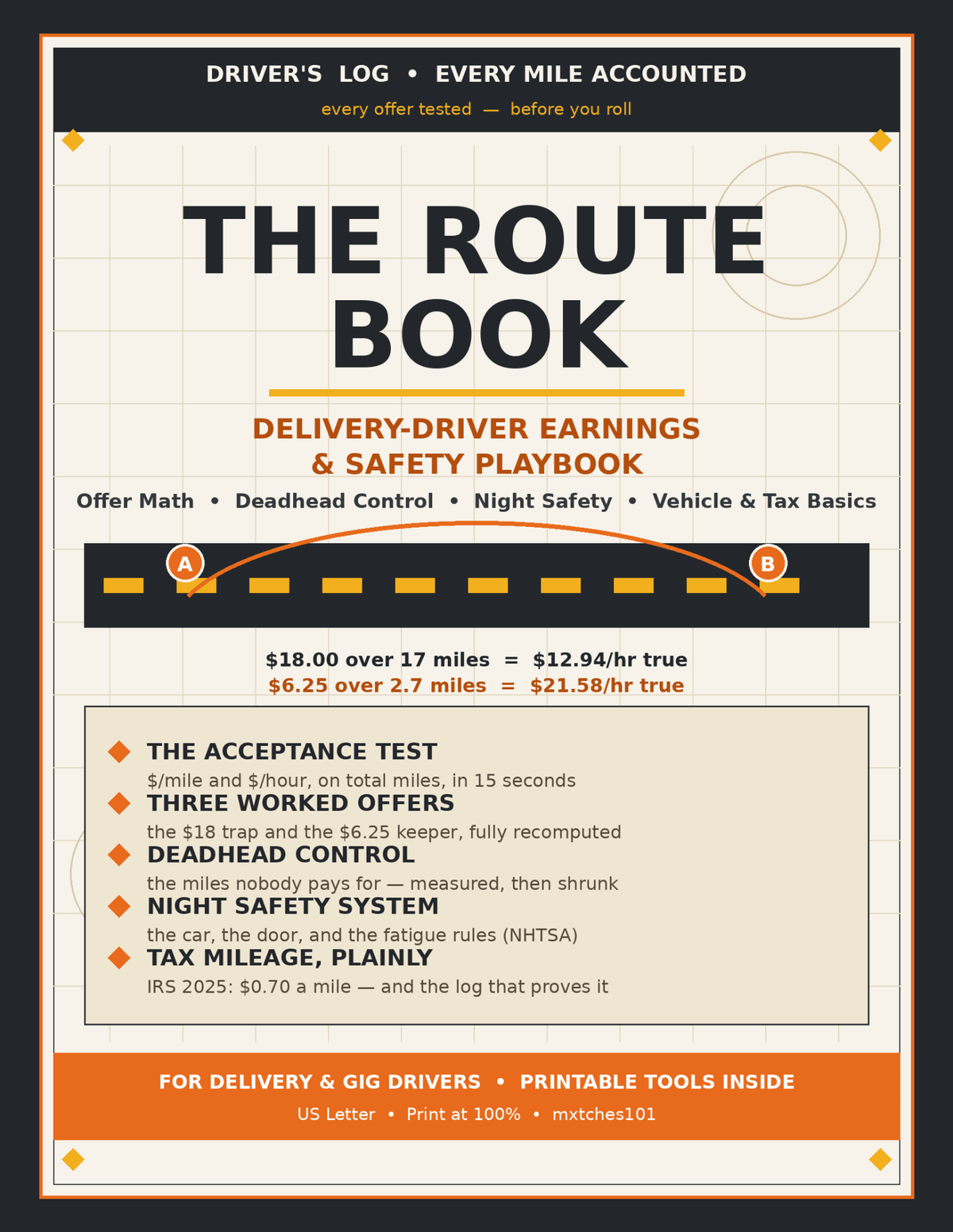
The Route Book — Delivery-Driver Earnings & Safety Playbook: Offer Math, Deadhead Control, Night Safety, Vehicle & Tax Basics
The Route Book — Delivery-Driver Earnings & Safety Playbook: Offer Math, Deadhead Control, Night Safety, Vehicle & Tax Basics
Couldn't load pickup availability
Digital download — delivered instantly after checkout.
The app says you made $23.67 an hour. The car took $75.60 of the night getting it done. Both numbers are real — and only one of them is on your screen.
The pain it solves: judging delivery work by gross. A $142 night over 168 miles nets $66.40 after the car is honestly paid — $11.07 an hour, not the $23.67 the app showed — and the biggest offer of the evening is routinely the worst-paid work in it, because nobody taught you to test an offer on total miles and real minutes before accepting it. This book is that test, plus the systems around it: deadhead control, night safety, vehicle costs, and the mileage log that turns your driving into a deduction instead of a guess.
What's inside (18 pages, US Letter, printable):
- The acceptance test: two formulas — $/mile on total miles, and true $/hour after vehicle cost — with honest guidance for setting your own floors, and a fifteen-second mental version for the phone screen
- Three fully worked offers, every line recomputed: an $8.50 offer that nets $15.82/hr true (decline), an $18.00 offer over 17 miles that nets $12.94/hr true (the trap — decline), and a $6.25 offer over 2.7 miles that nets $21.58/hr true (accept) — plus a stacked pair worked the same way at $22.10/hr true
- Deadhead control: the ratio formula, a worked week at 36.2% deadhead (94 of 260 miles), what trimming it to 28% is worth (~$490 a year at the example cost), and the five rules that move it
- Stacking and batching treated strictly as general practice plus arithmetic — including the wait-cost rule: at an $18/hr floor, every waiting minute costs about $0.30, so a 12-minute wait must add $3.60 just to break even
- A night safety system in two parts: the car and the door (pre-shift checks, doorstep protocol, the wrong-feeling rule), and fatigue and incidents, built on NHTSA's findings — 4–5 hours of sleep linked to more than five times the crash rate of 7–8 hours, high-risk windows of midnight–6 a.m. and 2–4 p.m., and the caffeine-plus-nap strategy
- Vehicle costs from AAA's Your Driving Costs 2024 ($12,297 a year for a new car, ~82¢/mile; fuel 14.90¢/mile; maintenance, repair and tires 10.13¢/mile), a four-line method for your own cost per mile, and a per-mile sinking fund that puts about $101.30 a month aside at 1,000 miles a month
- Tax mileage basics: the IRS 2025 standard mileage rate of $0.70/mile, year-labelled wherever it appears; the Publication 463 adequate-records standard (date, mileage, destination, business purpose, kept at or near the time); a worked 12,400-mile year worth an $8,680 deduction at the 2025 rate; and a pointer to The Miles Book in this store as the logging tool built for it
- A nightly 10-minute close-out and weekly scorecard system, edge-case decision rules (long waits, wrong addresses, breakdowns, dangerous weather), and four printable tools: a pocket offer-screening card, a shift log, a weekly scorecard, and a cost-per-mile worksheet
One discipline, kept throughout: no platform's stacking, pay, or acceptance policy is stated as fact anywhere in this book, because those rules change and could not be verified to the standard the rest of the book is held to — stacking is covered as general practice and arithmetic only, and page 18 says exactly what was hedged and why. Every verified figure is sourced on page 18: IRS, AAA, and NHTSA.
Honest scope: this is a working manual for delivery and gig drivers who own their vehicle costs and want to know their true hourly rate. It is not tax, legal, insurance, or financial advice — the tax chapter is general information that points you to a professional for your first-year method choice, and the insurance note is deliberately general because cover depends on your policy. It is not a platform tutorial: no app screens, no app-specific tricks, and nothing that depends on one company's current rules. If you drive under a fleet or employer arrangement where someone else carries the vehicle and the taxes, this book's math does not describe your job — do not buy it. If the car and the taxes are yours, it does.
Price: $15 for the 18-page printable PDF — less than one accepted Offer B costs you in an evening.
Digital download — delivered instantly after checkout.
Share